At a glance
Place in bright, indirect light and water when the topsoil begins to dry.


Scan the QR code to download
Google PlayEnter your pincode to see delivery dates.
Add an address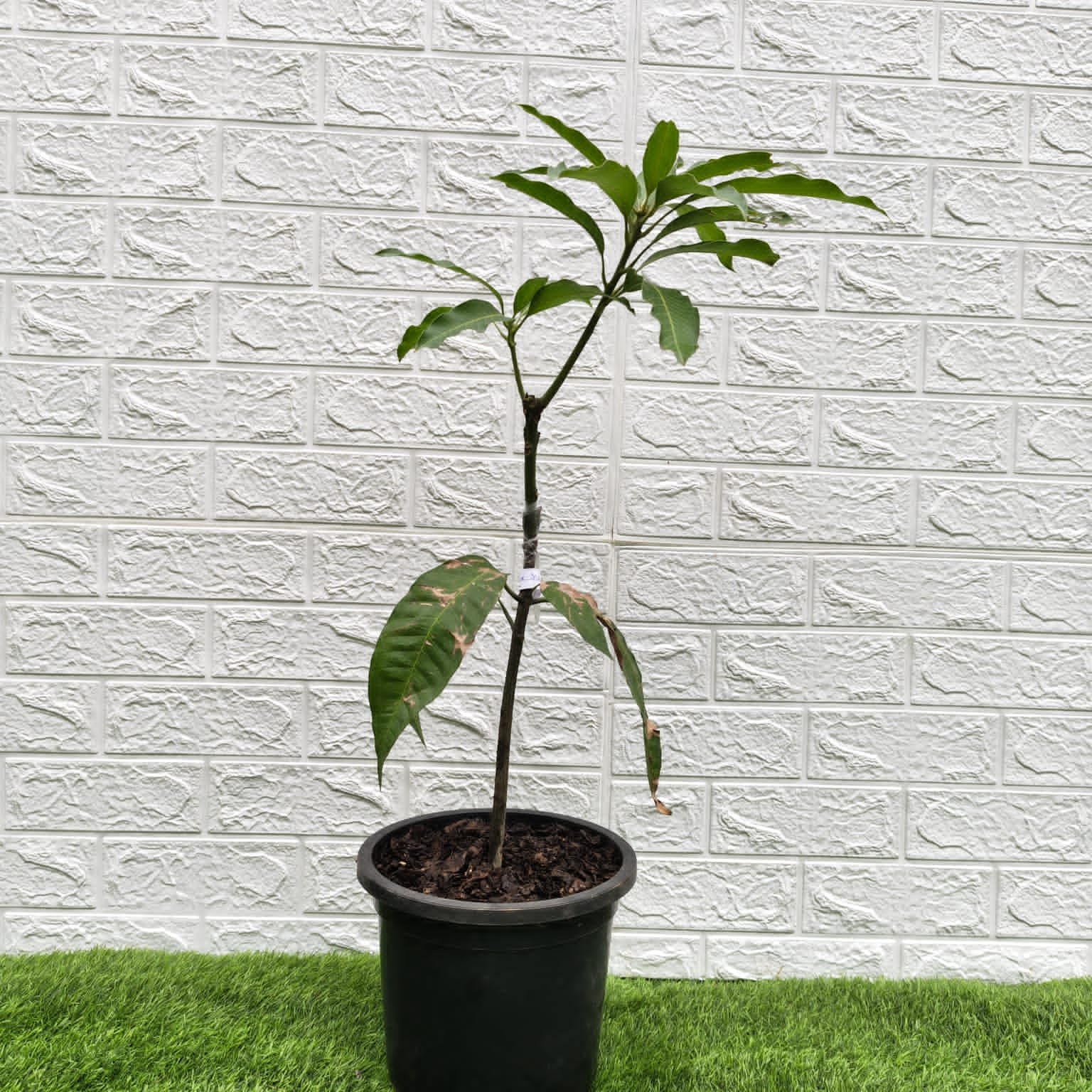
Bengal’s most loved mango — fibreless, intensely sweet, with a small stone and a very high edible portion. Grafted, so it fruits in two to three years.
Himsagar is the mango West Bengal and Bangladesh argue over. It ripens early, from mid-May, and is prized for pulp that is completely fibreless, deep saffron-orange, and sweet without being cloying.
The stone is unusually small and the skin thin, which gives Himsagar one of the highest edible portions of any Indian mango — most of what you hold is fruit. This is a grafted plant, so it carries the true variety and begins fruiting in two to three years rather than the decade a seedling takes.
Fruits weigh roughly 250–350 g with green-to-yellow skin. The pulp is fibreless, firm and deep orange, with high sugar and a distinct aroma. Because the stone is small and the skin thin, the edible portion is around 75–77% of the fruit by weight.
Our Bari-13 mango mix, with bone meal and neem cake added for a fruiting tree in a pot.
HimsagarClean, fertile and loose topsoil collected from a healthy garden or cultivation area.
If your garden soil is sticky or clay-heavy, increase the river sand or perlite share and reduce the cocopeat by the same amount.
29% VermicompostSlow-release nutrients and microbes.
19% CocopeatHolds moisture, keeps the mix light.
9% River SandDrainage channels; stops compaction.
3% Bone MealSlow phosphorus for roots and blooms.
2% Neem Cake PowderFeeds slowly and deters soil pests.
Pro Tip: Do not water while the tree is flowering — wet flowers drop. Resume once fruit has set.
Simple essentials for healthy and balanced growth.
Sunlight Full sun — 6 to 8 hours daily. Fruiting depends directly on it. Watering Deep watering every 7–10 days while fruit swells. Withhold during flowering and before harvest. Soil Deep, fertile, free-draining loam. Mangoes hate standing water around the trunk. Temperature Survives 0°C to 46°C. Best growth 25°C to 30°C. Damage below 10°C and frost sensitive. Fertilizer Well-rotted manure before flowering, then a potash-rich feed once fruit sets. Pruning Remove dead and crossing wood after harvest. Keep the centre open to light and air.What this plant enjoys, what it merely survives, and where it stops.
Ideal range 24°C – 30°C The range mango grows best in. Seedling growth peaks close to 30°C, and pollen performs best at 26.7–30.6°C, so the top of this range is where the tree is happiest — not the bottom. The tree as a whole tolerates 8–48°C. Active growth 25°C – 35°C Active growth happens best inside this window. Pollen tubes grow fastest at 27.9–32.1°C, which is why a warm flowering season sets more fruit. 0°C 4°C 11°C 24°C 30°C 35°C 40°C 48°C 52°C LethalCold stressChilling injurySafe but slowIdealActive growthWarm — tolerableHeat stressExtreme heat ❄️ Cold limits Below 10–12°C Chilling injury Harms pollen viability, causes flower and fruit drop, and affects the harvested fruit. Below 4°C Cold stress Young trees are stressed and the leaves take damage. 0°C and below Lethal limit Sustained or freezing temperatures can kill young trees outright. Young growth is severely damaged at 0°C, though a dormant tree can survive short-lived spells down to about −1°C, and an established mature tree might come through a brief, mild frost with only minor damage. 🌡️ Heat limits Above 40°C Heat stress Lowers photosynthetic efficiency and drops crop yields if it is prolonged. Up to 48°C Upper limit Trees can briefly withstand extreme spikes during fruit set, but continuous extreme heat causes sunburn on the fruit and reduces overall productivity.Figures from Useful Tropical Plants (Mangifera indica) for the 24–30°C best-growth range and the 8–48°C tolerance; PubMed 14975891 for seedling growth peaking near 30°C; PMC9837111 for pollen germination and pollen tube optima; and University of Hawaii System, ResearchGate and IgMin Research as summarised by Google for the cold and heat thresholds.
Where this plant performs across India's growing zones.
Cold hardiness Chilling below 10–12°C · lethal at 0°C Optimal growth temp 24°C – 30°C Winter dormancy None — evergreen Heat stress above 40°C (104°F) Ideal Indian zones Z5 · Z7 · Z10 · Z11 · Z12 · Z13 · Z14 · Z15 · Z18 Temperature range 0°C to 48°C ✅ Ideal — thrives here ✅ Z5 — Subtropical Monsoon · Winter 8–14°C / Summer up to 38°C Elevation 50–600m · Monsoon 5–6 months · Rainfall 1,800–4,000mm · Humidity 75–95% ✅ Z7 — Humid Subtropical · Winter 8–15°C / Summer up to 42°C Elevation 100–700m · Dry season 3–4 months · Rainfall 800–2,200mm · Summer hot — 38–42°C ✅ Z10 — Tropical Mid-Elevation Monsoon · Winter 9–15°C / Summer up to 38°C Elevation 600–1,500m · Monsoon 6–7 months · Rainfall 2,500–6,000mm · Humidity 80–95% ✅ Z11 — Tropical Monsoon Coastal · Winter 14–24°C / Summer up to 38°C Elevation 0–200m · Monsoon 5–6 months · Rainfall 1,400–4,000mm · No frost ever ✅ Z12 — Tropical Wet & Dry Savanna · Winter 11–17°C / Summer up to 40°C Elevation 300–1,000m · Dry season 5–6 months · Rainfall 700–1,600mm · Deccan Plateau — distinct wet and dry seasons ✅ Z13 — Tropical WDS Hot Interior · Winter 11–18°C / Summer up to 48°C Elevation 200–700m · Dry season 6–7 months · Rainfall 700–1,600mm · Summer scorching — 45–48°C peak ✅ Z14 — Tropical Wet & Dry Savanna Coastal · Winter 17–22°C / Summer up to 42°C Elevation 0–400m · Dry season 4–5 months · Rainfall 700–2,000mm · Coastal — humid year-round ✅ Z15 — Tropical Semi-Arid · Winter 12–16°C / Summer up to 45°C Elevation 450–600m · Humidity 35–75% · Rainfall 600–900mm · Dry season 7 months ✅ Z18 — Tropical Hot Semi-Arid · Winter 16–20°C / Summer up to 46°C Elevation 300–800m · Dry season 7–8 months · Rainfall 500–700mm · Western Ghats rain shadow ⚠️ Workable — grows, but needs help ⚠️ Z6 — Subtropical Monsoon Highland · Winter 10–13°C / Summer up to 32°C Elevation 800–1,400m · Monsoon 5–6 months · Rainfall 1,500–3,200mm · Dry season 5–6 months — no frost ever ⚠️ Z8 — Subtropical Semi-Arid · Winter 5–12°C / Summer up to 44°C Elevation 10–200m · Dry season 7 months · Rainfall 400–800mm · Semi-arid steppe ⚠️ Z9 — Cool Tropical Highland · Winter 5–12°C / Summer up to 28°C Elevation 1,600–2,500m · Nilgiri Hills / Western Ghats · Rainfall 1,500–3,000mm · Monsoon 5–6 months ⚠️ Z16 — Subtropical Hot Semi-Arid Continental · Winter 4–13°C / Summer up to 48°C Elevation 100–450m · Dry season 6–7 months · Rainfall 600–900mm · Summer scorching — 44–48°C peak ⚠️ Z17 — Subtropical Hot Arid · Winter 5–12°C / Summer up to 50°C Elevation 200–300m · Dry season 9–10 months · Rainfall <400mm · True desert climate ❌ Not suitable ❌ Z1 — Cold Alpine · Winter down to −20°C or below / Summer up to 20°C Elevation 3,000–5,500m · Rainfall <300mm · Dry season 8+ months · Deep dormancy — hardiest conditions ❌ Z2 — Cold Hills · Winter down to 1–5°C / Summer up to 25°C Elevation 1,800–3,000m · Rainfall 700–4,000mm · Monsoon 4–5 months · Full dormancy — excellent vigour ❌ Z3 — Subtropical Hills · Winter down to 3–8°C / Summer up to 28°C Elevation 1,500–2,500m · Rainfall 800–2,500mm · Monsoon 4–5 months · Full dormancy — best colour ❌ Z4 — Subtropical Highland · Winter down to 0–8°C / Summer up to 33°C Elevation 1,200–2,200m · Rainfall 500–3,600mm · Mixed monsoon · Dormancy sufficient at elevationTwo to three years for a grafted plant in good conditions. A seedling would take eight to ten.
Can I grow it outside Bengal?Yes — it fruits well across warm, humid India. It needs a cool dry winter spell to flower properly, so it does best where December and January are distinctly cooler.
Can it be grown in a pot?Yes, in a 60 cm or larger container, though fruit size and yield will be smaller than in the ground.
Why did the flowers drop without setting fruit?Usually rain or irrigation on open flowers, or a hopper attack. Keep water off the panicles and inspect them weekly.
Fibreless, intensely sweet, and a grafted plant that fruits in two to three years.
Fruiting time, yield, fruit size, sweetness and plant growth may vary depending on plant maturity, climate, sunlight, nutrition, soil and local growing conditions.
Place in bright, indirect light and water when the topsoil begins to dry.